Wednesday, 20 June 2012

Pembrokeshire's World Cliff Diving Championships will be a UK First


Abereiddi's Blue Lagoon.  The perfect venue for the UK's first World Cliff Diving Championships
©National Trust Images/David Sellman
 EXTREME athletes from across the globe will test their nerve on the Welsh coast this year when the National Trust host the world cliff diving championships.

The dramatic Blue Lagoon at Abereiddi in Pembrokeshire is to be the first British site ever to stage one of the seven legs of the Red Bull Cliff Diving World Series at the end of the summer.

 The National Trust owned cliffs will be the venue for the incredible televised competition which sees only the best and bravest divers in the world leap from a specially made platform 27 metres above the waves.

 “It is hard to understand just how extreme a sport this actually is. The cliff they dive off is the same height as an eight storey building,” said National Trust Ranger Nicky Middleton-Jones.

 “The divers hit the water at almost 90 kilometres an hour, and the impact on their bodies is such that even the slightest mistakes could be almost unimaginable.”

Abereiddi’s Blue Lagoon is the sixth stop of the series that sees 11 of the world’s best take on incredible cliff dives in France, Norway, Portugal, USA, Ireland and Oman.

 Nicky said: “The divers not only have to deal with fear and the elements, but they also have to impress the judges with perfectly executed twists and somersaults.

 “And, of course, they have to get the entry into the water absolutely right. Unlike normal diving where competitors hit the water head first, cliff divers have to enter the water feet first as the pressure of hitting the sea from such a height, at such speed, is too much for the head and shoulders to take.”

 British reigning World Champion Gary Hunt and former British Olympic Diver Blake Aldridge will lead the event on the 6, 7 and 8 September.

Nicky said: “The many dangers of cliff diving are obvious, and we remind everyone that these divers are experienced professionals taking part in a carefully managed event, with measured risks and a host of safety experts. The consequences of members of the public attempting something like this could be fatal.”

 1500 tickets for the event’s spectator area will be made available nearer the event.

Saturday, 16 June 2012

Kayaking at Stackpole


"You really have got the best job in Wales"

This is the reaction I sometimes get when I explain what my role entails.  Somewhat embarrassed, I mutter something about the hours spent working on our coastal strategy, traveling to meetings, responding to requests for information, managing the budget, preparing for events...

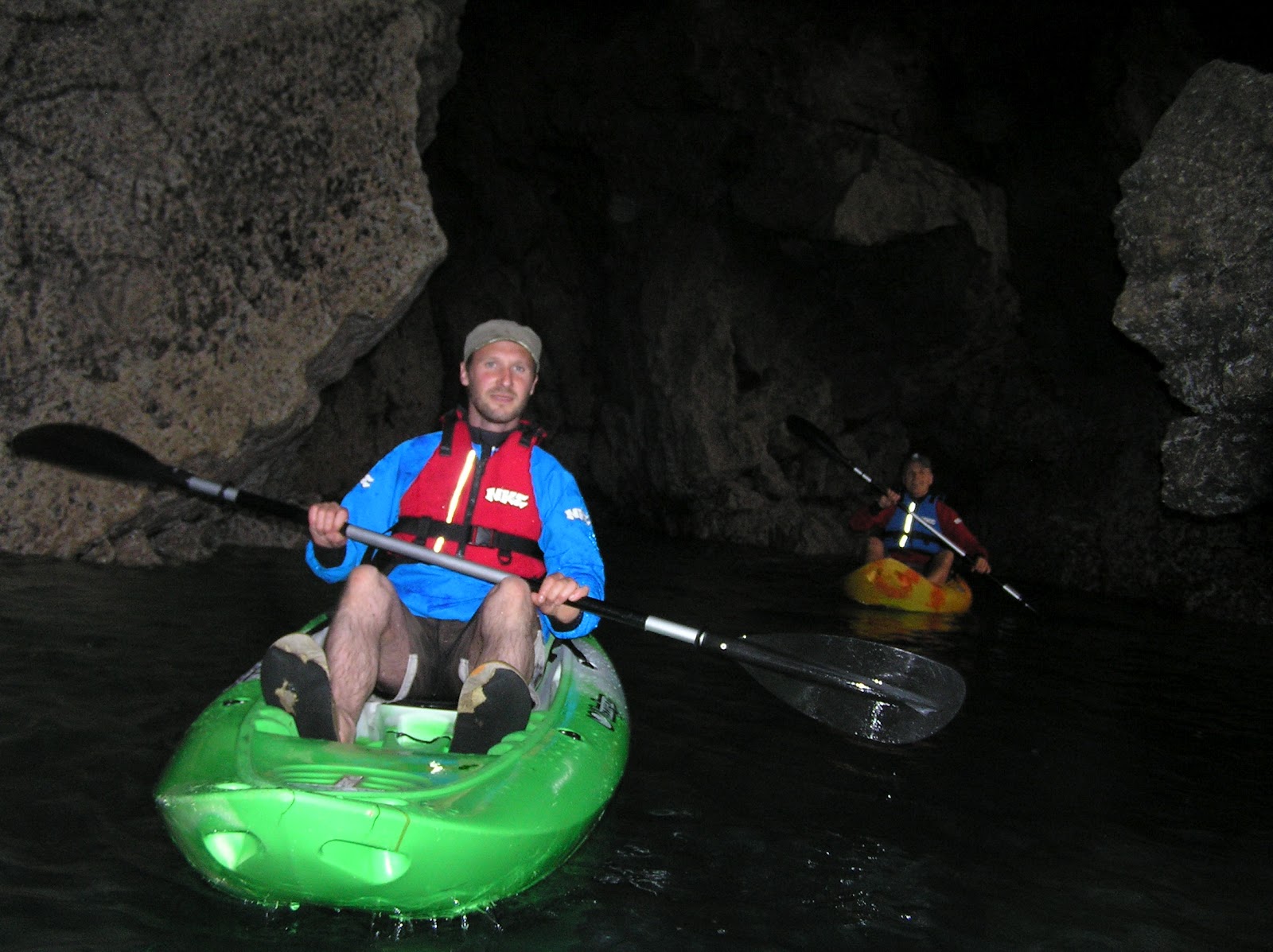
Of course, they don't believe me, but every now and then I get to do something that makes me think that I do have the best job in Wales.  And so it was earlier this week when I got to try out a kayaking taster session at Stackpole in South Pembrokeshire.

The team at Stackpole started to offer this experience last year;  the trial went well and this year they have been offering regular kayaking and coasteering sessions for the public, as an offshoot of our well-established Stackpole for Schools activity centre.

My companions for the trip was Jonathan Hughes, the Trust's General Manager for Pembrokeshire and Andy Godber, Operations Manager for Llyn, who has in mind setting up a similar activity in the north.  

I'm no stranger to kayaking, but that moment when you float free of solid ground, dip your paddle into the yielding water and feel your body responding to the water’s liquid buoyancy never fails to thrill me.

The next magical hour – spent soaking up the incredible beauty of Barafundle Bay at sunset, watching seabirds hurtling towards their lofty perches on Stackpole Head and reveling in the sheer excitement of paddling through a rock arch – will stay with me forever.

As we happily trundled the kayaks back up to the store, with the lure of a late-evening pint in the Stackpole Inn beckoning, I could not help reflecting on the restorative power of an hour or two spent free from the petty tribulations of our landlocked lives.

If you would like to sample the delights of Stackpole from the sea, why not book a taster session with our qualified instructor by phoning 01646 661425 or click here to visit our website.


Sunday, 27 May 2012

Pupils Meet their Ancestors on Llyn's Coast

Unloading goods from coasters at Porth Ferin, on the north coast of Llyn.  Notice the rope hoist used to lift the cargo onto the headland.
For centuries, seafaring was the lifeblood of our Welsh coastal communities.  Luxuries and staple goods of all description, both legal and illicit, were shipped into coves, creeks and beaches all around our rugged coast.

It's no coincidence that the word "Porth", so common around our shores, also means a doorway.

But nearly all these coves - which not so long ago echoed to the sounds of loading and unloading of cargoes - are now silent, save for the sounds of the waves, seabirds and the occasional walker or bather. 

So, where are the descendents of these fishermen, sailors and smugglers of old?  

Of course, many of them are still here, living lives far removed from those of their forefathers, in farms and villages dotted along our coastline.  

Wouldn't it be good if youngsters from these communities could catch a glimpse of the lives of their ancestors? Well, this is exactly what happened the other day at Porthor, or 'Whistling Sands' to the visitors.  

A group of primary schoolchildren from the nearby village of Rhoshirwaen were treated to a day they're unlikely to forget.  Their guide for the day was the National Trust's Community Ranger for Llyn, Robert Parkinson. 


Seaside Classroom: Community Ranger, Robert Parkinson challenges Rhoshirwaen pupils to discover clues to their seafaring heritage
Robert qualified as a teacher before joining the Trust's Llyn team and now spends his time working with community groups and schools around the peninsula.  His post is part-funded by the Heritage Lottery Fund under the Llyn Landscape Partnership, which aims to bring this area's unique heritage to life for the benefit communities and visitors.

Robert, who hails from the Llyn village of Llaniestyn, takes up the story:

"The children learned about the the sort of goods that were imported to the area in past centuries, like wine, tobacco and brandy"

"I got them to guess the identity of mystery objects by touch and with the aid of an aromatic clue.  We used "aroma cubes ", also used in the Yorvik visitor centre in York.  The "herring" and "fish-market" -scented ones were very popular!"

By involving all their senses, Robert was able to open up a window on the past for these Llyn youngsters; an experience that will ensure that the area's maritime heritage will live on for future generations. 

Sunday, 13 May 2012

Pembrokeshire Paradise Regained at Abereiddi


Take a look at this picture of Abereiddi, on the beautiful north coast of Pembrokeshire.  Let it take you - in spirit, if not in body - to that most beautiful part of the world.

I admit, the photo was not taken on a particularly beautiful day, but this needn't diminish the pleasure of your visit.  In your mind's eye, travel down the deeply-cut lanes bounded by banks of wildflowers and hawthorns until you reach the cluster of prettily painted houses tucked at the back of the beach.

You leave the houses behind you, nestling in their verdant scrubby gardens, and you're struck by that pleasurable assault on the senses that accompanies your arrival at any beach.

But this is not any beach.  Abereiddi has that rare combination of natural beauty - supplied by rugged cliffs and headlands; traditional architecture - supplied by the cottages with their limewash and slurried-roofs; and historic interest - supplied by the evocative ruins of the nearby slate quarries.

Now, how would you feel if I told you that this wonderful beach was going to be edged with steel girders, concrete blocks and huge boulders?  I'd imagine that you'd be rather upset.  Well, calm down, don't worry, it isn't.

If you've not been to Abereiddi before, you'll be surprised to learn that until recently, that's exactly what was here.  Take a look at the second photo (below) - taken a couple of months ago.

The decision to remove the ill-conceived 1960s sea defences - taken courageously by Pembrokeshire County Council was fully supported by the National Trust.  As the owner of a small part of the north end of the beach, the Trust commissioned a study that showed that this was a classic example of self-assured-destruction: that of sea defences being undermined by the very erosion that they had been built to stop.  

With the beach now restored to its more natural state, it can behave as it wants to: a dynamic shingle ridge that changes its position in response to storms. 

So-far-so-good, I hear you say.  

But working with the forces of nature is rarely straightforward.  See how the space available for parking has already been reduced by a couple of month's erosion.  What happens if the next storm takes another quarter of the car park? What if the coast path begins to erode? What about all the other sites in Pembrokeshire - and around our entire Welsh coastline - where there are aging sea-defences which were built with good intention but with little understanding of how the coast would respond to rising sea levels?

These are the sort of knotty questions that the National Trust, partners and the local community will need to address over the coming months and years.

When I next go to Abereiddi - this time in body rather than in spirit - I for one will not lament the loss of parking.  I'll take the Strumble-Shuttle bus down those flower-lined lanes and I'll have my picnic sitting on the shingle ridge where once stood a steel girder.

Monday, 30 April 2012

Where are the Welsh Coast's 'Magnificent 7' Walks?

This post was published for an event in 2012.

For an up-to-date post on Wales' favourite coast walk, click here


Porthdinllaen, Llyn.  Just one of the stunning locations that you can visit this weekend
If you're like me, you're probably suffering from cabin fever after this weekend's abysmal weather.  And now I'm back to work, the sun's shining through my office window.

What I really need is a bracing walk along the coast...but duty calls, and this pleasure will have to wait until next weekend.

Now, as you probably know, next weekend is one of the most important in the history of the Welsh coast.  Forget the 'big shop', this weekend you simply must go to the coast to celebrate the opening of Wales Coast Path 

Better still, why not be one of the very first people to walk on it after its official launch on Saturday? 

To mark this special occasion, our coastal rangers would like to invite you to join them on one of our Magnificent 7 celebratory walks. 

Whether it’s listening to the dawn chorus on Gower or exploring the historic ‘crog-loft’ cottages of Llyn, we have the walk for you.

Fron Deg, Rhiw, Llyn.  This beautiful coastal 'crog-loft' cottage is a destination for one of our coastal walks this weekend.  Come to learn about its history and the project to restore it.

Organised in partnership with Ramblers Cymru as part of the Big Welsh Walk weekend, the Trust’s guided walks will kick-off a season of events linked to the opening of the coast path.

Here's some details about the walks...

1. Church Bay, Ynys Mon / Anglesey
  • Sunday 6th May 10.30am
  • 5 miles 2.5hrs
  • A National Trust walk around the Church Bay Meet at the Swtan car park with Warden Bryn Jones
  • Contact Number: 01407711178

2. Porthdinllaen, Llyn
  • Saturday May 5. 4pm-6pm
  • Start and finish at Porthdinllaen car park at Morfa Nefyn
  • Circular walk with Ranger. Learn about the fascinating maritime history and wildlife of the village and beach.
  • Contact: 01758 760533.

3. Mynydd Rhiw
  • Sunday May 6. 2pm – 5pm.
  • Start and finish at Mynydd Rhiw lay by at summit of road between Bryncroes and Rhiw. Circular walk visiting the cottages of the tyddynnwyr (smallholders) hear from the Ranger about our exciting restoration project.
  • Contact: 01758 760533.
 
4. Cwm Tydu, Ceredigion
  • Saturday May 5. Time 10am - 1pm 
  • Start and finish at the beach at Cwm Tydu - walk along the coast and through the woods at Ryslip to see early spring flowers, along with the possibility of chough and pearl bordered fritillary. 
  • Contact: 01545 573030 / 07917266367
 
5. Solva, Pembrokeshire
  • Sunday May 6. 2pm-4pm 
  • A 4 mile circular walk from Solva Harbour to Nine Wells and back with National Trust Area Warden Andrew Tuddenham.You'll see ship wrecks, coastal forts and plenty of birds along the way. Some moderate gradients. 
  •  Contact 01348 837860.
 
6. Stackpole, Pembrokeshire
  • Saturday 5th May 10am – 2.30pm 
  • Starting and Finishing at Broadhaven car park. Walk with Head Ranger Chris Oliver along the lime stone cliffs of Stackpole, with a chance to see a variety of birds including Chough, Guillemots, Razor Bills and Gannets! Pause at Boat House Stackpole Quay for a tea before winding your way back through dunes, woodland, farmland and the Bosherston Lakes back to Broadhaven. 
  • Contact National Trust at Stackpole on 01646 661359 for further details.

7. Cwm Ivy, Gower
  • Sunday May 6 4:30am. 
  • Dawn Chorus walk on Coast Path at Cwm Ivy. Listen to the countryside wake up, with experts on hand to identify the bird call. A magical experience. 
  • Contact 01792 390636 or email: gower.admin@nationaltrust.org.uk

STOP PRESS: 

EXTRA WALK ORGANISED:

8.  Porthglain to Abereiddi, Pembrokeshire
  • Saturday 5 1:30pm 3 hr walk 
  • A 4 mile circular walk from Porthgain to Abereiddi and back, with National Trust Seasonal Assistant Ranger Stephen Merrill. See the dramatic remains of a quarrying industry that once exported roadstone all over the UK. Some steps and moderate gradients. Start at Porthgain outside The Shed restaurant
  • BOOKING (essential) National Trust North Pembrokeshire Estate Office, Mathry
    01348 837860.


Mwynhewch eich taith gerdded ar yr arfordir y penwythnos yma!

Enjoy your walk!


Wednesday, 18 April 2012

Pearls Discovered in Carmarthen Bay

Morfa Bychan, Gilman Point and Pendine Sands from the summit of Ragwen Point
I owe my Carmarthenshire colleagues a bit of an apology.  Well, more of a whopping big one, actually.  

I was preparing a map of the National Trust's Welsh coastal properties, to be used at future coastal events.  And here's the thing, I left out the little group of properties that look out over Carmarthen Bay.

In my defence, they are often overlooked, sitting as they are half way between the more famous and dramatic properties on the Gower peninsula and the Pembrokeshire coast.

But as I discovered today, they have a secluded charm all of their own, and as a result I would like to confess my appreciation of modesty as opposed to drama, when it comes to coastal places to visit.

The best things in life are often hard to find, and these little stretches of coast are no exception. 
  
They are concealed down ramsom-lined lanes, tucked into wooded valleys echoing with birdsong, secreted amongst brambly hillocks and nestled within unspoilt farmland where time passes at a more leisurely pace than the rest of the world.

But their beguiling modesty is deceptive.  They hold treasures that more boastful areas would trumpet about.   
 
At Morfa Bychan Ragwen beach, tucked in between craggy headlands a short distance west of Pendine, I discovered remains of bomb-blasted concrete walls that were built as part of the preparations for D-Day and said to have been visited by Winston Churchill.  


On Gilman Point, which once reverberated to the thunderous exhausts of ‘Babs’, during J. G. Thomas’ 1927 fatal land-speed record attempt, I traced the remains of a prehistoric hill fort and spied my first holly blue butterfly of the season, flitting amongst ivy flowers.

Later, at Mwche and Pentowyn near Llanybri, I looked across the Taf estuary at Dylan Thomas’ "timeless, mild, beguiling island of a town" and realised that the inspirational view from the Boathouse is actually protected by the National Trust.


And finally, after strolling through verdant timeless farmland as rich as cream, and through the unspoilt yard of the dairy farm at Lord’s Park, I gasped as I came upon a view as fine and expansive as any in Wales – the whole sweep of Carmarthen Bay from Worm’s Head to Caldey, with Somerset, Devon and Lundy in the distance.


So, where were the pearls I hear you ask? 

Well, someone recently said to me that the Trust’s Welsh coastal properties are like a string of pearls, and that my job is to try to thread them together.  As I got into the car for my long journey home, I pondered on the fact that although some of our pearls are big and world-famous, it is the smaller ones that are the true gems of our coast. 

Long may they remain overlooked. 


Monday, 2 April 2012

Around the Welsh Coast in 14 Days!

I can't believe that it is only two weeks since I started my new role.  It feels like I've been at it for months!

The first week was a great opportunity for me to get acquainted with the NT Wales Office in Llandudno - somewhere I know well already of course.  

At least I could see the sea (over the heads of the shoppers on Mostyn Street) from my temporary desk.  

In case you are thinking that being in the office for four days is not the best way to promote the Welsh coast, it was very useful in that I could start working with the excellent support team that will be helping me once I really get into the job.

As a reward for the indoor-days, I visited our hidden-gem of a property at Glan Faenol and met up with inspirational warden, John Whitley (see previous blog post).  I was disappointed to hear that the Wales Coast Path may not be crossing this fascinating NT-owned stretch of the Menai coast, due to yet-to-be-resolved access issues on neighbouring land.  "All in the fullness of time, Richard", I thought.

Before my next meeting (with CCW Coast Path project officer) I managed a quick visit to the Anglesey side of the Strait to visit Caeau Glan Mor (NT) and take in this view of Ynys Gorad Goch and Telford's bridge.

The little-visited NT viewpoints along the Menai will soon be enjoyed by Coast Path walkers


Week 2 saw me heading off to South Wales, with working visits to Llanerchaeron and Stackpole - two utterly different but equally fascinating properties.  The main purpose of my trip was to meet the Pembrokeshire team at their Start of Season Meeting.  It was great to meet such a dedicated and enthusiastic team.  One outcome of my presence was that I promised to try (successfully as it turned out) to get Coast Path marathon runner, Ari, to visit my colleagues at the Tudor Merchant's House at Tenby.

On my way back, I called in at Penbryn, one of the hidden gems of Ceredigion.  Although it was already evening, with the sun sinking low over the Irish Sea as I strolled onto the golden sands of the beach, I was pleased to come across the local part-time NT Ranger, Glyn, who spends his evenings keeping this beach clear of litter.  I promised myself that I would return to do the popular dark-skies star-gazing walk that starts here. 

Evening sun on Penbryn beach - Nefoedd!