Wednesday, 17 June 2015

Day 10: Puffin & preditor: Solva to Tenby

A rose between two thorns? Today's crew, Amanda
Amanda, our Fundraising Consultant and latest crew member, arrived bright and early at 7am, and we headed out of Solva harbour over St Bride's Bay.  The Solfa coast, Southwood estate and Sheepfields, Littlehaven, three of our properties that flank the bay, faded into the distance as we approached the fearsome Jack Sound.  The presence of increasing numbers of seabirds, busily crisscrossing our route, heralded the proximity of Skomer.  We spotted our first puffin, bobbing on the sea with it's beakfull of sandeels, and soon there were squadrons of them hurtling past, their frantic flight reminding us of over-wound clockwork toys.
Jack Sound, with the Deer Park and Midland Isle
Despite it's reputation, the Sound was smooth, with just the occasional upwellings and swirling eddies tugging at the rudder, hinting at the power of the tide race which would soon be upon us if we didn't keep moving.  We passed Midland Isle, the Trust's only sizable non-tidal island in Wales and rounded the Deer Park into the bay off Marloes Beach with its tidal Gateholm.  Soon St Anne's Head hove into view and I spotted Kete, where a wartime radar station for the tracking of low-flying aircraft was once located.  Crossing Milford Haven's busy shipping lanes we aimed for Freshwater West where we intended heading out to sea to avoid the Castlemartin firing range exclusion zone.
Range safety vessel, Predator comes alongside
But before we could do this, from apparently nowhere appeared the threateningly named Predator, a range safety vessel which requested that we headed three miles offshore due to live firing on the range. As we approached the Stackpole estate, another safety vessel accosted us to make sure we kept our distance.  Eventually we anchored off Stackpole Quay, dropped off Amanda and joined our colleagues, who by happy coincidence were having an evening social kayak and barbeque.
Stackpole colleagues see us back out to Capercaillie
We then headed for Tenby, where we were to meet our next colleague-passenger tomorrow.  This journey took us past Manorbier and Lydstep Head, the Trust's first property in Pembrokeshire, donated in 1936.  We eventually rounded Tenby's St Catherine's Island and moored in the harbour with minutes to spare before the ebbing tide landed us gently on the sand at 10pm.
The bright lights of Tenby, from the harbour
Go to Day 11

Day 9: Shore leave: St David's to Solva

The Solva coast, best experienced on foot.  (c) National Trust/Joe Cornish
Last night's arrival at Solva was a day early, thanks to the extended voyage on Saturday. As we had a new passenger to pick up tomorrow, this meant that we had a day's shore leave today.  The question was, which bit of the Pembrokeshire coast to walk?  South to Newgale or north to St David's?

This conumdrum was resolved by Tony, Solva's friendly harbourmaster as we were paying him for the mooring.  "Get in the van, boys, I'll run you up to St David's."  It seems that when the tide's out, there's little going on down in the harbour, so Tony does a spot of gardening on the side.

We called in at the NT shop at the city centre and had a chat with Cath, the cheerful manager, who was doing what she usually's doing when I see her: chatting to visitors about things to see and do.  After talking about our trip and the mysterious arrival of a flock of red kites in the area (feeding on puffin chicks?) the conversation moved on to Gregory Peck, a tame seagull that has his own twitter account.  This was the signal we needed to get going on our walk back to Solva.

Experiencing the coast whilst sailing has been a bit like moving along an unrolling scroll.  An endlessly moving view, continually revealing itself ahead of you and retreating behind you.  It may be heresy to suggest it in this blog, but this perspective doesn't always show off our coast at its best. To really appreciate our spectacular coast at its most beatiful, you have to get onto it and walk it.

And the coast between Porth Clais - with its small fleet of fishing boats snuggling behind the protective arm of harbour wall - and Solva, must be amongst the most beatiful anywhere.  A sucession of spectacular wildflower-speckled cliffs and sandy bays of clear waters tinted a turquoise of tropical intensity.
Capercaillie on her mooring at Solva
There was nothing tropical in its temperature when I leapt off the boat back in Solva harbour. A spirited swim around the boat was enough to cool me off after the walk in the warm sunshine.  Writing on the boat, as John went in search of a mobile signal, I listened to the early-evening sounds of the harbour. Little motor boats came and went, children played, youths shouted and the Celtic longboat rowing teams pulled past, chatting cheerfully as they rowed.  The other essential part of harbour life at Solva - the Harbour Inn and (yet another) Ship Inn - beckoned, and we enjoyed a meal and pint to celebrate the end of our shore leave.

Go to Day 10

Sunday, 14 June 2015

Day 8: A meeting with the bitches. Fishguard to Solva

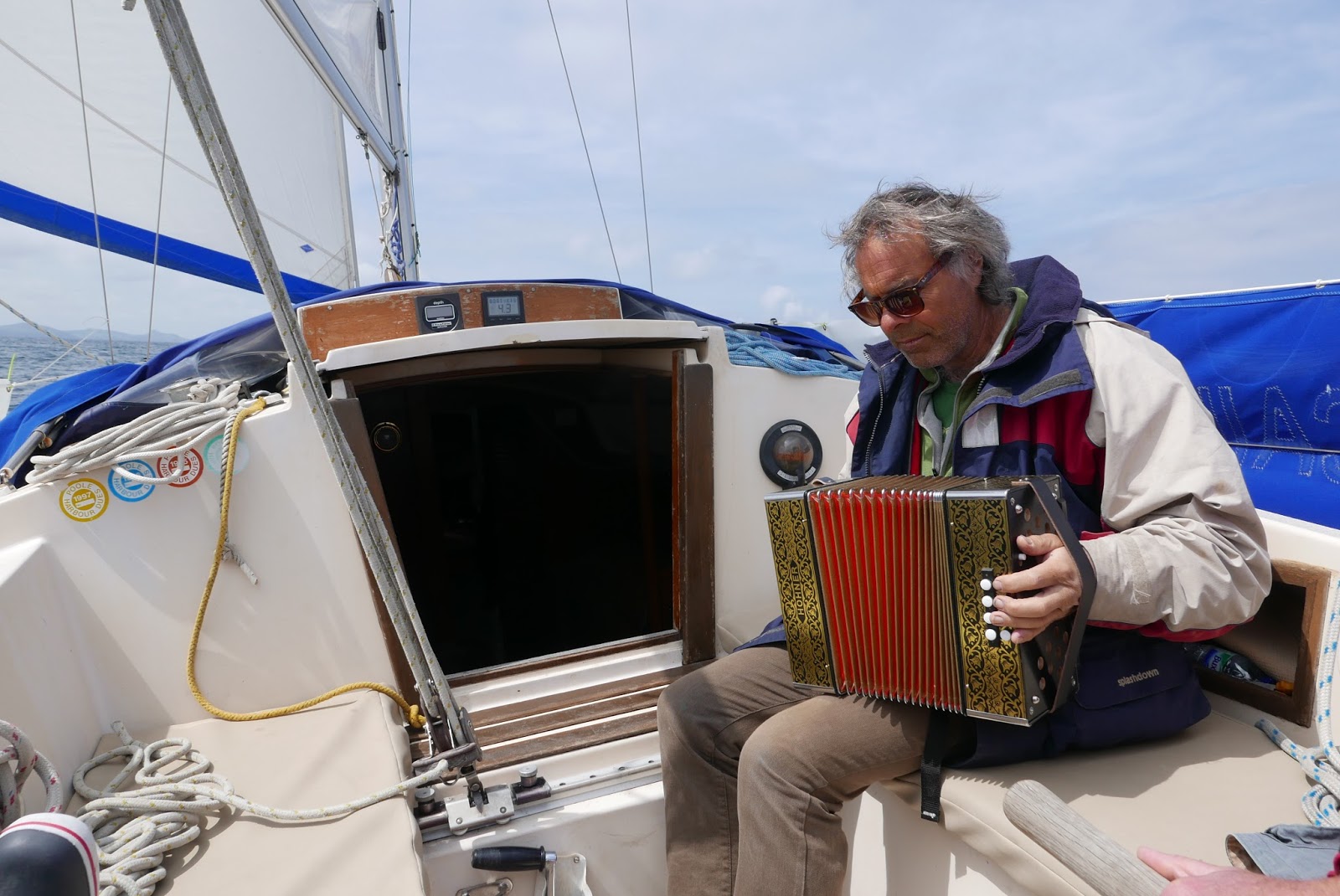
A blue sky, fair breeze and full sail.  A good time to get the squeezebox out
For once, the mischievous machinations of the tides were in our favour. We were aiming to repeat our smooth transit of the Bardsey Sound with a similar strategy for Ramsey.  That is, to let the tide race-away until it slows, then hop on-board for a smooth ride before it turns and the tidal gate closes again.  And last night's calculations had declared that we had time for a leisurely vegetarian cooked breakfast in Fishguard before weighing the anchor. Having experienced local yachtsman Tim on-board for a second day certainly made crewing much easier.
Site of the shambolic Napoleonic mini-invasion at Carreg Wastad Point
Soon we were rounding Pen Anglas, Carreg Wastad Point and then Strumble Head.  With a fair breeze and blue sky, we sailed past all the other spectacular north Pembrokeshire NT places, such as Garn Fawr, Abermawr, Abereiddi and St David's Head. In about an hour, we were heading inexorably into the jaws of Ramsey sound, surrounded by jagged reefs with ominous names such as the Craig Gafaeliog (grabbing rock), the Horse, the Bitches and the Shoe, we were carried comfortably on the last gasp of the tide race.
Escaping the Ramsey Sound into St Bride's Bay
The expanse of St Bride's Bay opened out before us and with the wind on the beam reach, we had a cracking sail along the Treginnis peninsula to Solva.  Negotiating its twisted approach into calmer waters, we were reminded that to arrive at a secluded fishing village by boat gives you a stronger sense of arrival than by any other means.  After all, it's the act that defines the place and ultimately, it's spirit.  I for one had the words of one of Solva's most famous sons, Mike Stevens, in my head as I approached:  "Mae ysbryd Solfa'n galw nawr"  (Solva's spirit calls me now).

Go to Day 9

Day 7: "Ahoy me haaarties" Aberystwyth to Fishguard


Today's motley crew: David (Volunteer Ranger), Tim (Llanerchaeron Head Gardener),
 Gwen (Ceredigion Ranger),  John and me
When under pressure, John abandons his usual affable tact and switches to skipper mode.  This is the John that burst into the harbourmaster's office as I was arranging the onward postage of the elusive stop-solenoid.  “We’re leaving… NOW!” 

With the tide approaching the point when leaving Aberystwyth ceases to be possible, and shortly before we were about to cast off, our motley crew arrived.  Minutes later we were motoring though the rain into a gloomy Cardigan Bay, with our crew’s high spirits almost drowning out the throb of the engine.
Gwen, giving us a quick lesson in marine ecology
Pirate-inspired amateur-dramatics soon faded away as we started to take a lumpy swell and the rain beat down even harder.  Gwen pointed out a succession wonderful coves and headlands that she and her team of volunteers look after.  Craig yr Adar, Coebal, Cwm Silio, Cwm Tydu, Lochtyn, Penbryn and, finally, after about 4 hours of pitching and rolling, Mwnt.

Gwen and David
By this point the wind had increased to a stiff northerly, the swell had become even more tempestuous and two of the crew had ‘donated their breakfast to Neptune’.  At least, we thought, it will be all over when we round Cardigan Island and head into the Teifi estuary. One glance into the jagged jaws of the estuary made it clear that we would have to press on to Fishguard, another 3 hours of stomach-churning sailing.

Coming ashore at the old harbour at Fishguard
They say that the best cure for seasickness is to sit under a tree; well, a stroll through Fishguard for fish and chips seemed to do the job just as well.  We said our farewells to Gwen and David who were having a lift back home with Alison, Tim’s wife, and headed back to Capercaille.  

Not for the first time in this trip, Capercaille started hammering on the bottom as the tide reached full ebb, a serious inconvenience that would make sleep impossible.  This necessitated a quick repositioning to an anchorage, which returned the boat to a more soporific cradle-rocking movement.
John and Tim going ashore for re-fuelling
Go to Day 8

Friday, 12 June 2015

Day 6: Estuarine spendour - Barmouth to Aberystwyth


I’m learning to feel excited rather than worried at the sound of wind whistling in rigging when I wake up.  It means one thing: fast sailing.  And my eager anticipation was fulfilled by an exhilarating sail south to Aberystwyth.  The broad valleys of the Mawddach, Dysyni and Dyfi channeled and concentrated the wind giving us the occasional extra boost, helping us along at a top speed of 6.9 knots and leaning the boat right over.
The mountain fastness of Cader Idris, towering over the Dysyni valley
We’ve found that there’s no such thing as ‘dolphin fatigue’.  The wonder of the first encounter repeats itself every time.  Today’s performance took place off Borth.  As soon as we spotted the fins, they’d already seen us and were heading our way.  Seconds later they were riding the bow, leaping clean out of the sea and clapping their tails onto the water.  The sight of a pair of them alongside the bow, twisting and swapping places at high speed will stay with me forever.

We moored off Aberystwyth to wait for the tide, finally coming alongside the marine berth at 3pm, guided by a very friendly and helpful harbourmaster.
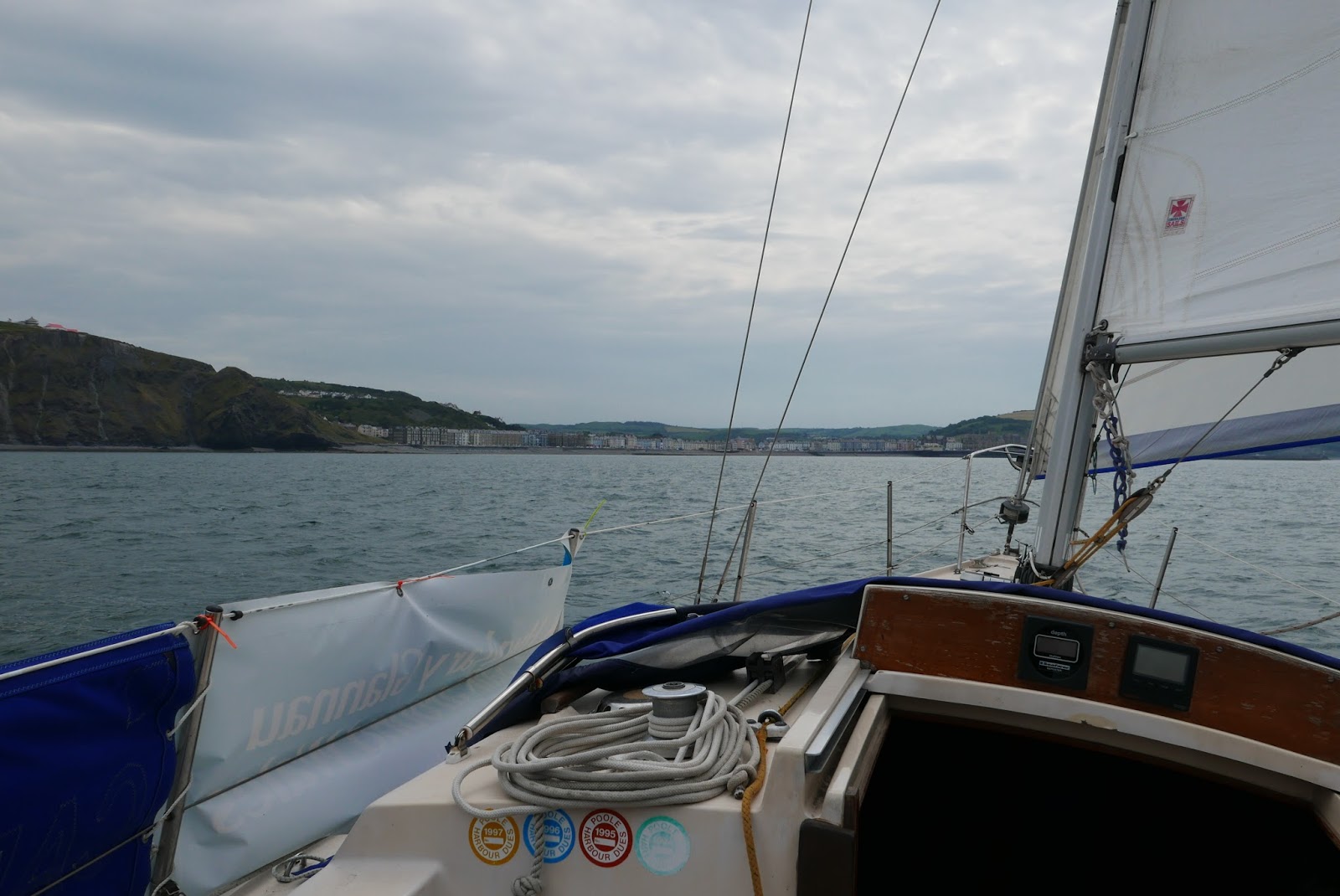
Aberystwyth appears over the bow on a broad reach
Today’s coastline – wonderful though it is – is a bit of an ‘empty quarter’ when it comes to NT Neptune coastline.  Tomorrow will be different, as we enter the coastline of the Cardis.

Go to Day 7